
Contact Us
info@revolutionevasia.comJoin our Mailing list
 Chat With Us
By Isha Qureshi • Fri Jan 16 2026
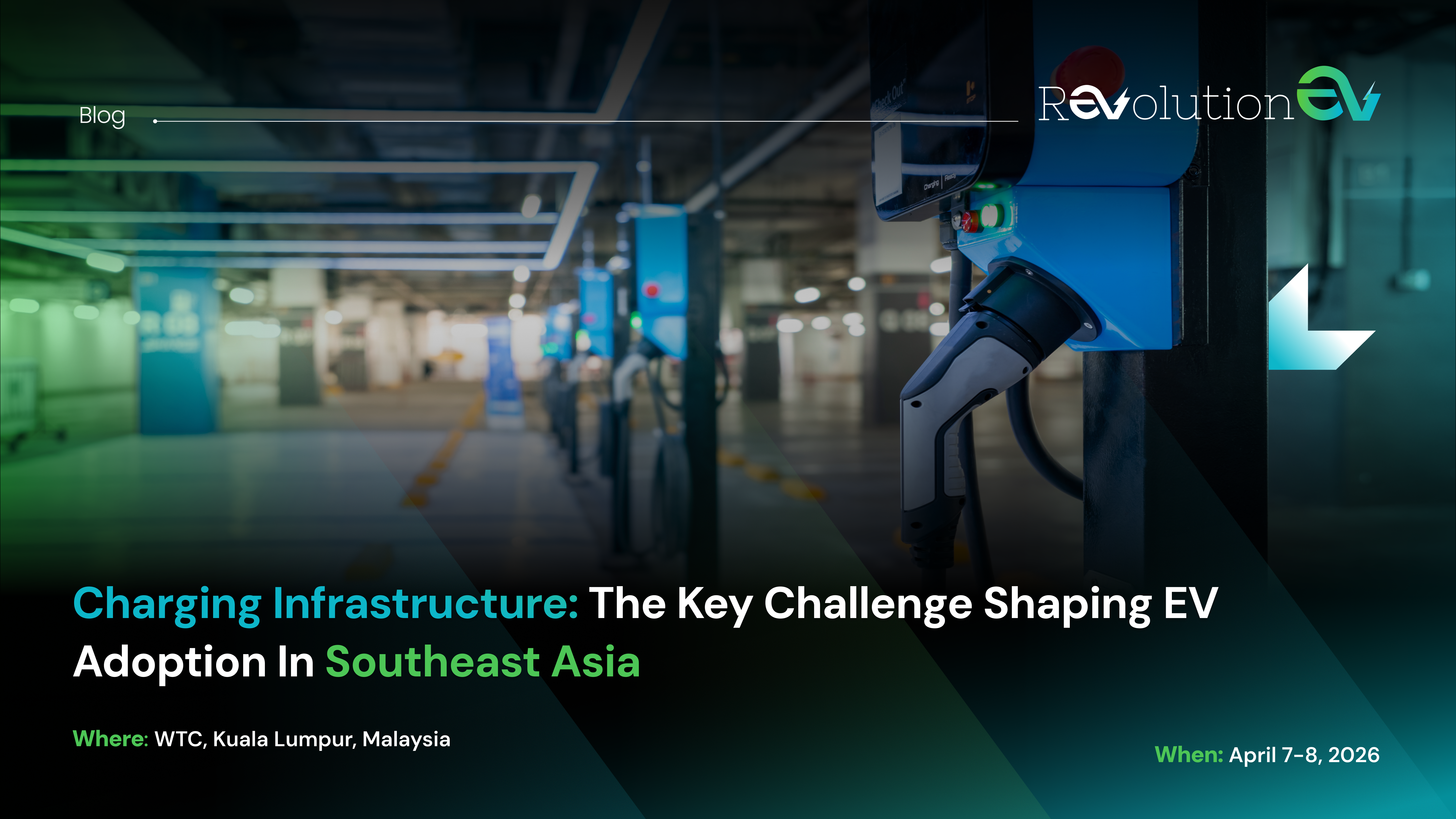
In the Growing global EV ecosystem, Southeast Asia is rapidly emerging as a key growth region. Countries like Malaysia, Thailand, Indonesia, Vietnam, and Singapore are actively pushing toward electric mobility because of urbanization, rising middle-class populations, supportive government policies, and increasing environmental awareness. However, despite strong intent and increasing investment, one of the significant barriers that continues to impede EV adoption throughout Southeast Asia is charging infrastructure. The availability, reliability, and accessibility of charging infrastructure play a crucial role in shaping consumer confidence. While EV technology itself has advanced significantly, the supporting ecosystem in many Southeast Asian markets is still in its early stages of development. For potential EV buyers, the lack of visible and dependable charging options often outweighs the benefits of lower emissions and reduced operating costs, making infrastructure the primary bottleneck in the region’s EV transition.
One of the most prominent issues that remains a major concern for consumers across Southeast Asia is range anxiety. Even though the latest EV models offer improved driving ranges, the perception of limited charging availability persists, particularly outside major urban centers. In countries with long commuting distances, island geographies, or intercity travel dependence, drivers are skeptical about switching to electric vehicles without assurance that charging points will be readily available along highways and regional routes. The uneven distribution of charging stations further intensifies this challenge. Suburban areas, secondary cities, and rural regions often lack sufficient charging coverage. However, major cities such as Singapore, Bangkok, Kuala Lumpur, and Jakarta have seen faster deployment of public chargers, supported by government initiatives and private investment. This imbalance restricts EV adoption to urban pockets only and limits the scalability of electric mobility across the broader Southeast Asian market.
Charging speed and reliability also remain critical challenges. In various Southeast Asian countries, the number of fast-charging stations is still limited, resulting in longer charging times and congestion during peak hours. Inconsistent charger uptime, lack of standardized connectors, and fragmented payment systems can create friction for electric vehicle users. For many consumers, the charging experience does not yet match the convenience and familiarity of traditional refueling, slowing the transition from internal combustion engine vehicles. Often considered as a key leverage of EV ownership, home charging is not universally accessible in Southeast Asia. A significant portion of the region’s population lives in high-density housing such as apartments and condominiums, where installing private chargers can be challenging. Limited parking access, regulatory hurdles, and infrastructure constraints mean that many potential EV owners must rely heavily on public charging networks, further increasing pressure on already limited infrastructure.
Another important element is grid readiness and energy management. Expanding EV charging infrastructure in Southeast Asia requires more than just installing chargers; it demands coordinated upgrades to power grids and energy distribution systems. As fast chargers draw high power loads, utilities must ensure grid stability while balancing residential, commercial, and industrial energy demands. In emerging markets, this adds complexity and increases the cost of large-scale deployment. Inspite of all these challenges, Southeast Asia also presents a significant opportunity for innovation and growth in EV charging infrastructure. Governments across the region are introducing incentives, subsidies, and regulatory frameworks to encourage private-sector participation. Regional collaboration, public-private partnerships, and cross-border standardization efforts are beginning to shape a more connected and resilient charging ecosystem. Advancements in technology are forging new routes. Smart charging solutions, renewable energy integration, energy storage systems, and data driven charging management are gaining traction across Southeast Asia. These innovations have the potential to address grid constraints, improve charger reliability, and reduce operational costs while supporting sustainability goals.
At Revolution EV Asia 2026, we see charging infrastructure not just as a challenge, but as a cornerstone of Southeast Asia’s electric mobility future. By bringing together key policymakers, automakers, charging solution providers, energy sectors, startups, and investors, the region can accelerate infrastructure development and unlock mass EV adoption. As Southeast Asia moves forward in its electric mobility journey, one reality stands out clearly, the success of EV adoption will depend on how quickly and effectively charging infrastructure evolves. Building a reliable, accessible, and scalable charging network is not optional; it is essential to powering the region’s EV revolution.