
Contact Us
info@revolutionevasia.comJoin our Mailing list
 Chat With Us
By Isha Qureshi • Tue Feb 24 2026
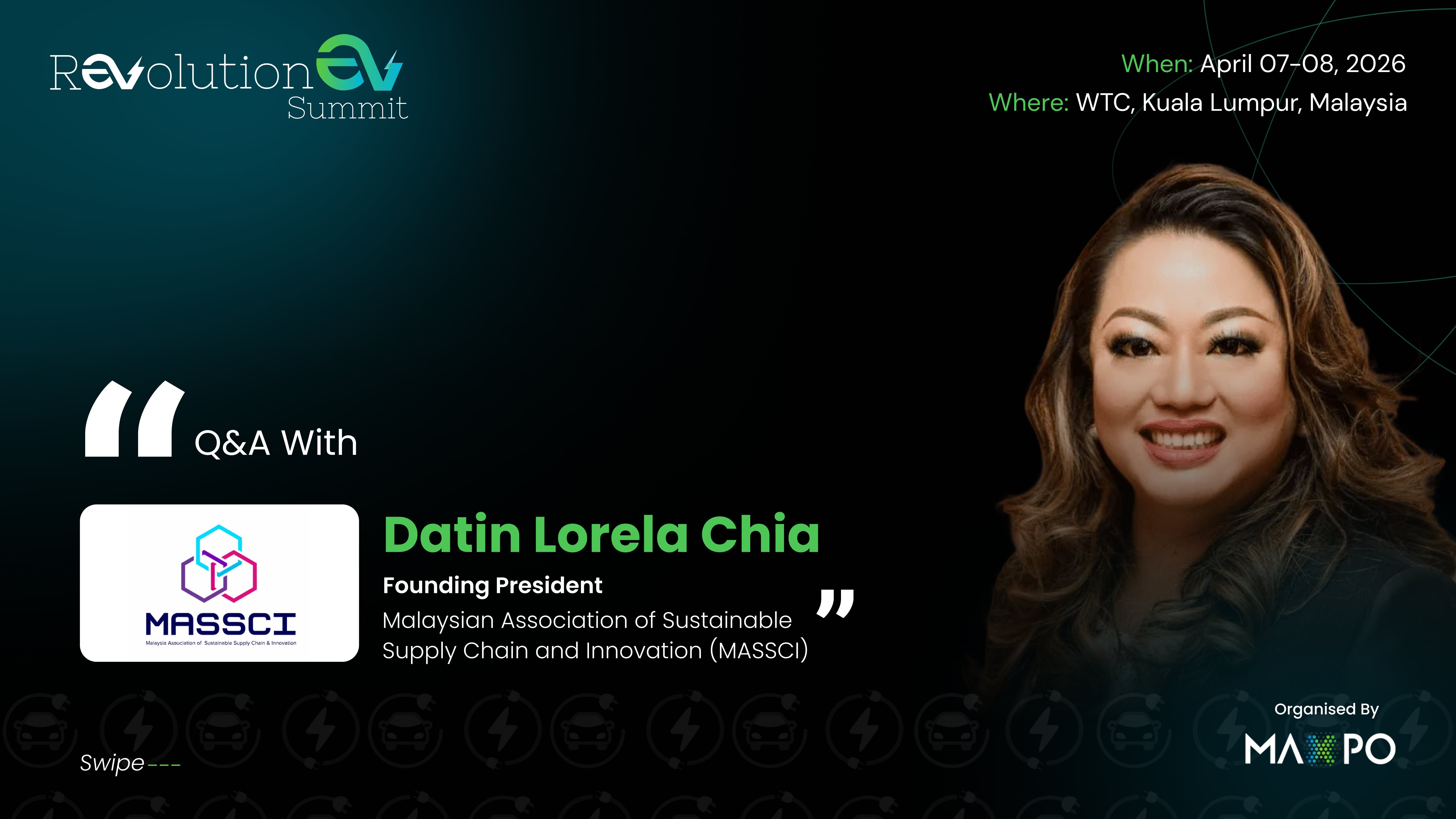
Datin Lorela Chia drives sustainability in Malaysia’s machinery and engineering sectors, helping industries strengthen supply chains and build future-ready ecosystems. A trained lawyer turned strategist, she brings analytical rigour and policy insight to the industrial transformation agenda. As Founding President of MASSCI and Vice President I of MEIF, she leads programmes that connect policy, industry, and technology with the digital shifts reshaping competitiveness and value creation.
Q&A Overview
In this Q&A, Datin Lorela frames the EV transition as a supply chain transformation rather than merely a mobility shift, emphasising that Malaysia’s real opportunity lies in building industrial depth across batteries, power electronics, precision engineering, automation, and compliance-ready manufacturing. She highlights tightening precision standards, the growing importance of traceability and carbon transparency, and the need for honest readiness assessments among manufacturers and SMEs. The discussion underscores that sustainability must function as operational infrastructure, policy clarity shapes competitiveness, and cross-sector collaboration is essential. Ultimately, she positions EV as a test of industrial maturity, where execution discipline and systems integration will determine Malaysia’s depth of participation in global EV supply chains.
Q&A Section:
I see EV less as a transport shift and more as a supply chain shift.
When we talk about EV, we are really talking about batteries, power electronics, rare earth components, thermal systems and charging infrastructure. These are industrial capabilities. If Malaysia approaches EV purely from an assembly perspective, the participation will remain shallow.
The real opportunity lies in strengthening precision engineering, automation depth and compliance-ready manufacturing so that Malaysian suppliers can enter battery modules, inverter systems and high-spec components. EV is revealing which countries have industrial depth and which do not.
There are a few structural shifts that are quite clear.
First, precision standards are tightening. Battery casings, BMS housings and drivetrain components demand tighter tolerances and more integrated engineering across suppliers.
Second, documentation and traceability are becoming central. EV supply chains require visibility on component origin, carbon intensity and quality assurance. Many factories still treat documentation as an administrative function rather than a production function. That mindset will have to change.
Third, factories need honest readiness assessments. Before pursuing EV contracts, companies need to understand whether their automation, process control and audit discipline meet EV-grade expectations. Without that clarity, scaling can become expensive very quickly.
In EV, sustainability is not a branding layer. It is operational infrastructure.
Battery sourcing, lifecycle emissions and mineral traceability are under scrutiny globally. That means governance systems, procurement discipline and traceability mapping are no longer optional.
If upstream suppliers cannot demonstrate transparency, downstream resilience weakens. EV supply chains reward coherence across tiers, not isolated compliance at the final assembly stage.
EV manufacturing raises the bar.
Higher precision, integrated automation, stricter quality assurance and more disciplined documentation are becoming baseline expectations. Incremental digitalisation will not be enough.
Machinery capability must evolve in alignment with these expectations. When factories improve process control and automation maturity, participation in battery components and advanced electronics becomes feasible. Without that foundation, EV ambition remains aspirational.
Interestingly, the gap is not usually machining skill.
The larger gaps appear in systems integration — carbon reporting literacy, digitally connected production systems, audit documentation discipline and coordination across supplier tiers.
EV supply chains operate under tighter scrutiny than conventional automotive segments. SMEs that recognise this early and upgrade their integration maturity will find themselves better positioned.
Cost pressure is real, especially in EV where margins can be tight.
However, when sustainability is integrated into process optimisation — energy efficiency, material yield improvement, predictive maintenance — it often strengthens operational resilience.
The difficulty arises when sustainability is treated as an external requirement rather than embedded into production design. In EV supply chains, operational discipline and sustainability increasingly reinforce one another.
Policy clarity reduces hesitation.
Battery traceability regulations, carbon reporting frameworks and standards harmonisation directly influence supplier qualification. Companies that pay attention to regulatory evolution tend to position themselves more strategically.
Market access is increasingly shaped by compliance coherence, not just production output.
EV cannot scale within a single sector.
Manufacturers, energy providers, charging infrastructure developers, recyclers, certification bodies and digital solution firms all influence the ecosystem. Battery supply chains depend on grid readiness and materials recovery pathways as much as on machining capability.
Fragmented development slows progress. Coordinated alignment accelerates it.
EV is moving beyond experimentation. Execution now matters.
For Malaysia, this is a window to strengthen precision capability, traceability systems and measurable transformation readiness. The companies that combine engineering depth with compliance discipline will secure more durable participation in evolving EV supply chains.
EV is testing industrial maturity. The preparation we do now will determine how meaningfully we participate.