
Contact Us
info@revolutionevasia.comJoin our Mailing list
 Chat With Us
By Isha Qureshi • Mon Dec 22 2025
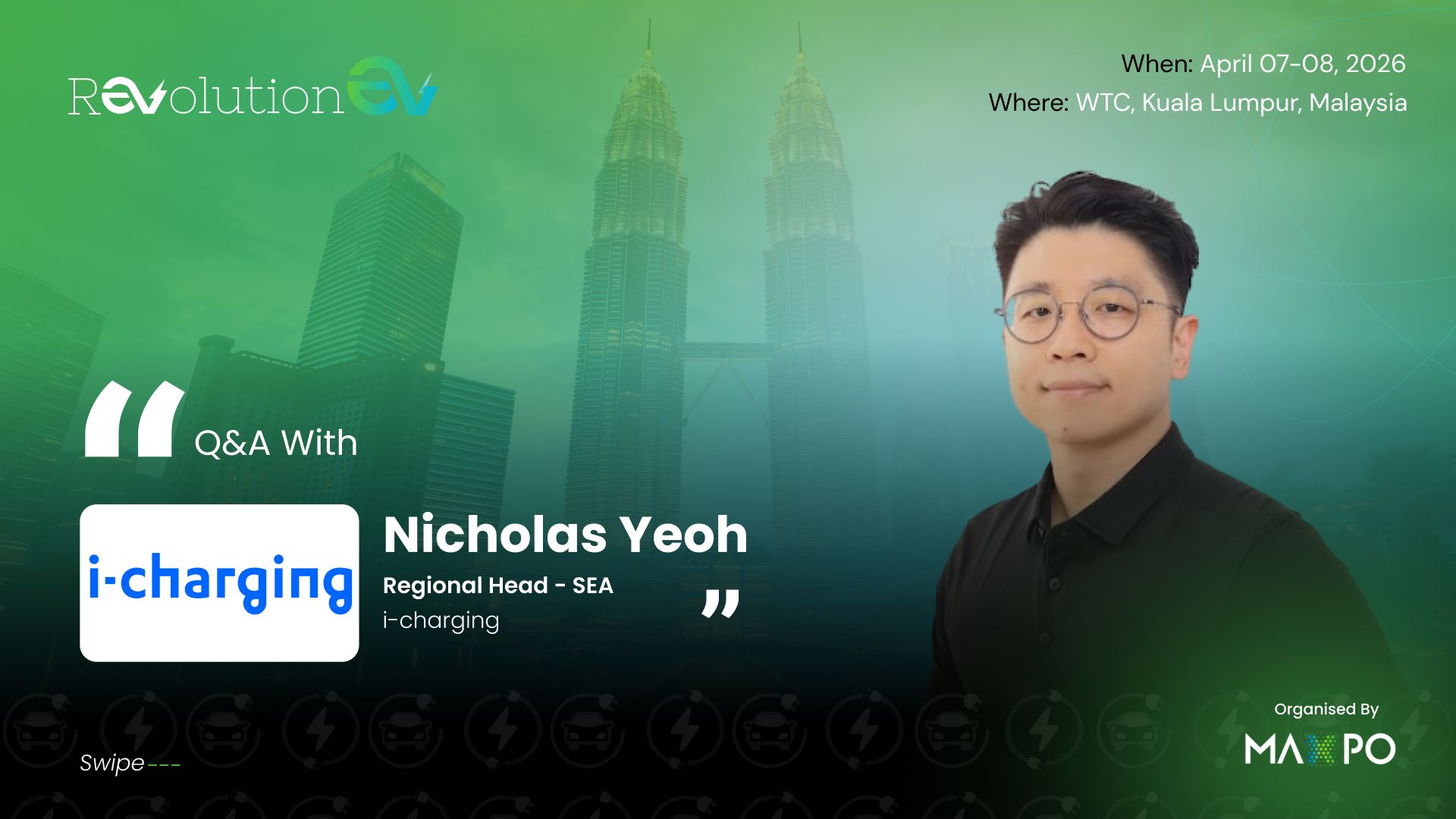
Nicholas Yeoh, the regional Head of Southeast Asia at i-charging, oversees the company’s expansion and operations across the region, working closely various stakeholders to accelerate the transition to electric mobility. i-charging, headquartered in Portugal, develops advanced and flexible EV charging solutions designed to serve all charging standards and use cases — from urban fast charging to highway infrastructure. With more than 15 years in e-mobility and technology, Nicholas is focused on enabling the rollout of intelligent, future-ready charging networks that align with Southeast Asia’s evolving transport and energy needs.
Q&A Overview
In this Q&A, Nicholas Yeoh shares his perspective on the development of EV charging infrastructure in Southeast Asia. He discusses the importance of clear government policy, long-term infrastructure investment, and the shift toward intelligent, software-driven charging networks. The conversation also explores Southeast Asia’s growing role in the global e-mobility ecosystem and the priorities required to deliver reliable, scalable, and future-ready charging solutions across the region.
Q&A Section:
Aligned with the United Nations Sustainable Development Goals (UN SDGs), we aim to lead the transition toward an electric mobility future that significantly reduces global carbon emissions. Given SEA’s strong progress in vehicle electrification, we believe that i-charging’s well-designed and future-proof charging solutions will be instrumental in achieving the region’s sustainability goals.
The EV charging industry has evolved rapidly, resulting in a wide range of options offered by its supply chain today. While this diversity is beneficial because it gives operators numerous options to fit their specific needs, it also necessitates caution. Operators must be meticulous in their choice of solutions to avoid installing gear that may not be fit for purpose, or that lacks the necessary runway to accommodate future technologies and network expansion.
Success starts with clear, foundational government policies and the commitment to uphold them. These policies will catalyse local investments, naturally guiding the supply chain to align with the frameworks set by leadership.
While fast charging is becoming commonplace, the industry's evolution is far from complete. Electrification is rapidly extending beyond road vehicles, with sectors like maritime, aviation, and mining setting aggressive decarbonization goals. Soon, the strategic pairing of sophisticated software with charging hardware will be the primary driver enabling this wide range of new use cases.
Modern chargers transcend simple hardware. They integrate sophisticated software that allows operators to seamlessly connect with, monitor, and configure field-installed units, significantly enhancing operational ease and flexibility.
We aim to be recognized as a trusted supplier of charging solutions. We are committed to playing the long game and consistently delivering a superior user experience in EV charging to accelerate the adoption of EVs.
I anticipate a sizable onshoring of the supply chain in SEA over time. Driven by the need for expansion and diversification, SEA is an increasingly attractive region for manufacturing and OEMs. I believe SEA will grow into a key hub for the e-Mobility supply chain, mirroring its foundational role in the semiconductor industry.
Governments and private businesses play distinct, yet complementary roles. The government's primary function is to establish realistic policies that align with its own decarbonisation and economic goals. While referencing existing case studies is useful, each jurisdiction requires careful study to navigate its unique barriers. Private businesses, meanwhile, must ensure they can sustain the initial burn-rate. This is a long-term endeavour, similar to the roll-out of telecommunications infrastructure, where profits were not immediately realised.
A significant challenge facing operators today is the lack of adequate tools for managing their field assets. While they may receive basic notifications when a charger is offline, their visibility and control are often limited. i-charging has addressed this by developing comprehensive tools that provide full visibility into asset status and performance, along with powerful features like configuration capabilities and Over-The-Air (OTA) firmware updates. This investment instils greater confidence in operators utilising our equipment.
SEA is proving to be a highly fertile region for e-Mobility adoption, evidenced by substantial growth over the last five years. This is only the beginning of its potential."