
Contact Us
info@revolutionevasia.comJoin our Mailing list
 Chat With Us
By Isha Qureshi • Thu Feb 12 2026
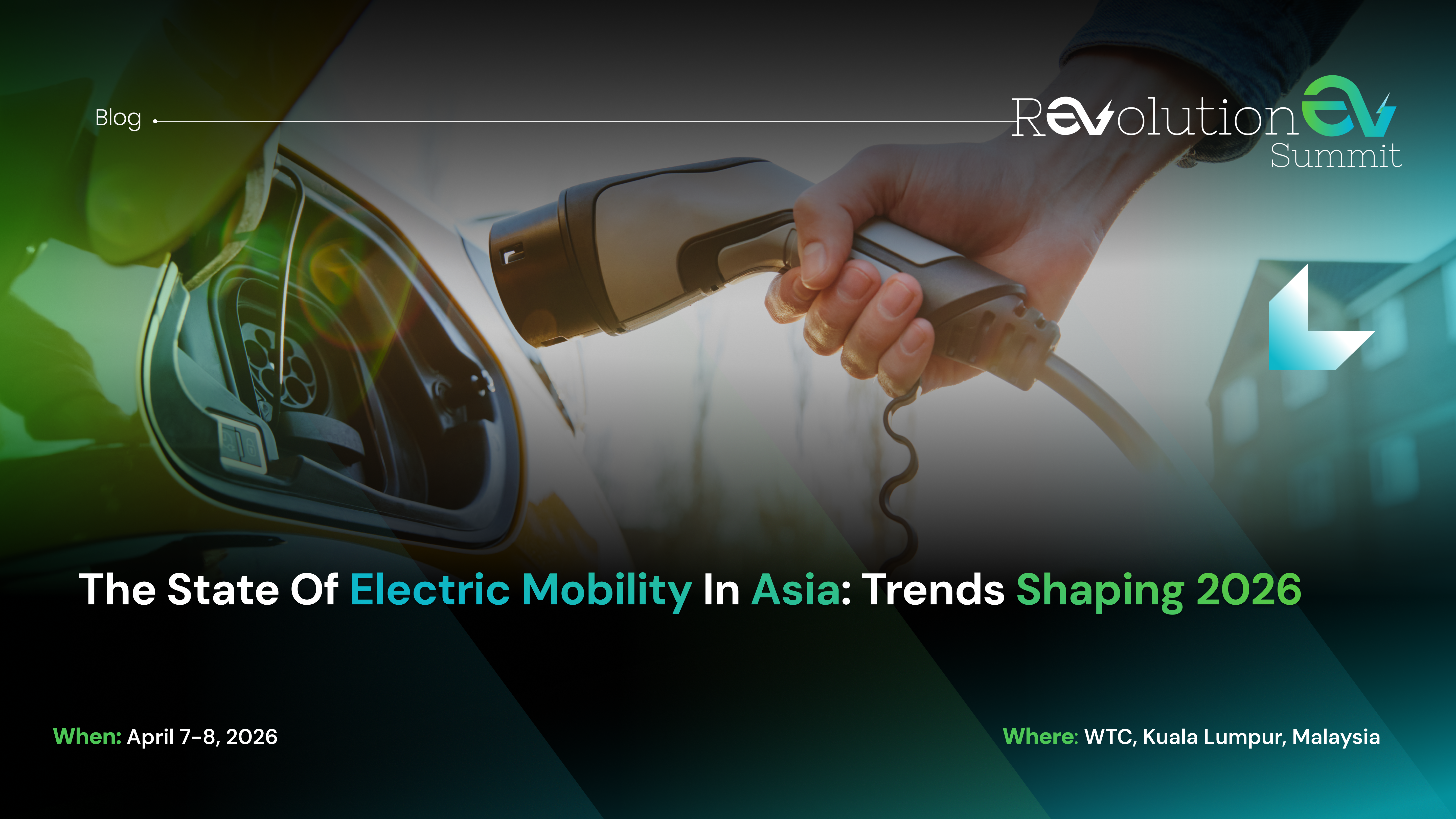
Asia’s electric mobility revolution is accelerating with unprecedented momentum. What began as a policy-driven initiative to curb urban pollution and reduce fossil fuel dependence has rapidly evolved into the epicenter of global electrification. With governments, industries, and consumers increasingly aligned around low-carbon objectives, 2026 is poised to mark a pivotal transition from rapid growth to systemic dominance in Asia’s transport ecosystem. According to GlobalData projections, the Asia-Pacific electrified vehicle market is expected to reach 23.8 million units by 2026, expanding at a 25.6% CAGR between 2021 and 2026 underscoring the region’s central role in shaping the future of mobility.
China remains the undisputed leader, producing over 16 million EVs in 2025 alone and supporting nearly 50% EV penetration in new car sales, backed by more than 8.6 million charging piles nationwide. Its vertically integrated supply chain from battery minerals to vehicle assembly continues to anchor Asia’s electrification momentum. Meanwhile, emerging markets are closing the gap. India recorded approximately 2.3 million EV sales in 2025, representing 8% of new vehicle registrations, with two-wheelers accounting for 1.28 million units, and early 2026 passenger EV sales surging 51% year-on-year. Across the ASEAN-6 markets, electrified vehicle sales grew by roughly 62–63% in 2025, reaching an average 17–18% share of light-vehicle sales, while Singapore surpassed 40% EV adoption in new registrations, positioning itself as Southeast Asia’s most mature EV market.
Asia’s electrification narrative extends far beyond passenger cars. Electric two- and three-wheelers remain foundational to mobility across densely populated urban centers, where affordability and efficiency outweigh range and performance. China sold over 5.9 million electric two-wheelers in 2023, while India registered more than 850,000 units and emerged as the world’s largest electric three-wheeler market, supported by last-mile logistics, ride-hailing fleets, and urban delivery ecosystems. By 2026, these segments will represent not only mobility solutions but economic enablers, supporting gig economies and low-cost urban transport at scale.
Commercial electrification is also accelerating. Electric buses and fleet vehicles are gaining traction across China, India, South Korea, and Southeast Asia as cities target emissions reductions and fuel savings. Corporate fleet operators are increasingly electrifying logistics and delivery vehicles, driven by total cost of ownership (TCO) advantages, ESG mandates, and urban low-emission zones. This shift signals a structural change where electrification is no longer consumer-led alone but enterprise-driven.
Infrastructure development remains both a challenge and a major opportunity. While China leads globally with 8.6 million charging points, Japan and South Korea follow with over 150,000 and 90,000 public chargers respectively. India, despite strong EV sales growth, had approximately 8,000+ public chargers as of 2025, and smaller ASEAN markets collectively account for around 12,000+ stations highlighting persistent gaps. However, 2026 will see accelerated deployment of fast-charging corridors, battery swapping networks for two- and three-wheelers, and private-sector participation in destination and workplace charging. Grid modernization, smart charging, and vehicle-to-grid (V2G) pilots will also gain momentum, integrating EVs into broader energy transition strategies.
Battery technology and manufacturing will further shape Asia’s EV trajectory. The region dominates global lithium-ion battery production, with China, South Korea, and Japan hosting major gigafactories. Investments into LFP (lithium iron phosphate) chemistry, sodium-ion research, and solid-state battery pilots are advancing energy density, safety, and cost competitiveness. By 2026, declining battery prices will continue to narrow the cost gap between EVs and internal combustion vehicles, accelerating mass-market adoption.
Policy remains the backbone of Asia’s EV surge. Subsidies, tax incentives, production-linked schemes, and electrification mandates are shaping national roadmaps. China’s long-standing incentive structures have mainstreamed adoption, while India’s coordinated federal and state-level measures are accelerating both demand and infrastructure deployment. ASEAN economies are leveraging fiscal incentives to attract foreign investment and strengthen domestic manufacturing, with Thailand targeting over 52,000 EV exports by 2026 as part of its regional strategy. Increasingly, policies are shifting from purchase subsidies to ecosystem development, including battery recycling, local component manufacturing, and renewable energy integration.
Investment flows mirror this transformation. Venture capital, sovereign funds, and automakers are channeling billions into EV startups, charging networks, battery innovation, and mobility platforms across Asia. Strategic partnerships between energy providers, automakers, and technology firms are redefining value chains, turning mobility into a connected, electrified, and data-driven industry.
By 2026, Asia’s electric mobility ecosystem will reflect deeper structural integration EVs commanding a rising share of vehicle sales, two- and three-wheelers reinforcing everyday transport systems, commercial fleets electrifying at scale, and charging networks expanding despite uneven distribution. Regulatory frameworks will evolve toward emissions alignment, grid integration, and circular battery economies. In essence, 2026 will represent a defining milestone: electric vehicles will no longer be niche alternatives but dominant drivers of Asia’s automotive transformation, catalyzing economic opportunity, industrial growth, energy transition, and sustainable urban development across the region.